

Getting a tattoo in Los Angeles means navigating hundreds of studios, and the signs of a quality tattoo studio are not always obvious from the outside. Some places look polished on Instagram but fall short on safety, skill, or genuine client care. Others are quietly exceptional. If you are looking for custom fine line work or a truly personalized experience, knowing exactly what to evaluate before you book protects both your health and your investment in permanent art.
Table of Contents
- Signs of a quality tattoo studio start with licensing
- Strict sterilization and hygiene protocols
- Transparent portfolios showing healed tattoo quality
- Professional client care and consultation experience
- Quality ink and supply sourcing with safe storage
- Comparison table: key signs of quality tattoo studios
- What the industry gets wrong about "quality"
- Experience the standard at The Sunroom LA
- Frequently asked questions
Key Takeaways
| Point | Details |
|---|---|
| Visible licensing | A quality tattoo studio displays current licenses and health permits openly, proving legal compliance. |
| Strict hygiene | Proper sterilization with autoclave spore tests and single-use needles prevent infection risks. |
| Healed portfolios | Photos of healed tattoos demonstrate lasting craftsmanship beyond fresh ink appearance. |
| Respectful consultations | Professional artists engage clients with patience, clear consent, and fair payment policies. |
| Safe inks | Reputable studios use tattoo inks tested for contaminants and store them properly to ensure safety. |
Signs of a quality tattoo studio start with licensing
Licensing is the floor, not the ceiling. It is the minimum standard that separates a legitimate operation from one that puts you at risk. In Los Angeles, this is non-negotiable.
A quality studio will have its licenses posted where you can see them without asking. That includes the facility permit and each artist's individual practitioner license. If you have to request them or the staff seems uncomfortable when you do, that is a clear warning sign. Quality studios display licenses prominently and follow OSHA bloodborne pathogens training requirements for every working artist.
California has specific legal requirements that go beyond a basic business license. Studios must comply with the Safe Body Art Act, which includes facility permits and yearly or biennial health inspections depending on the county. This law exists because tattooing involves breaking the skin, which creates real exposure to bloodborne pathogens if protocols are not followed.
Key licensing indicators to look for:
- Facility permit posted visibly in the studio
- Individual artist licenses available for each practitioner
- Bloodborne Pathogens (BBP) training certificates renewed annually
- Current health inspection results available on request
- No hesitation when you ask to see any of the above
Strict sterilization and hygiene protocols
Once you confirm the paperwork is in order, look at how the studio actually operates. The physical environment tells you a great deal about how seriously a studio takes client safety.
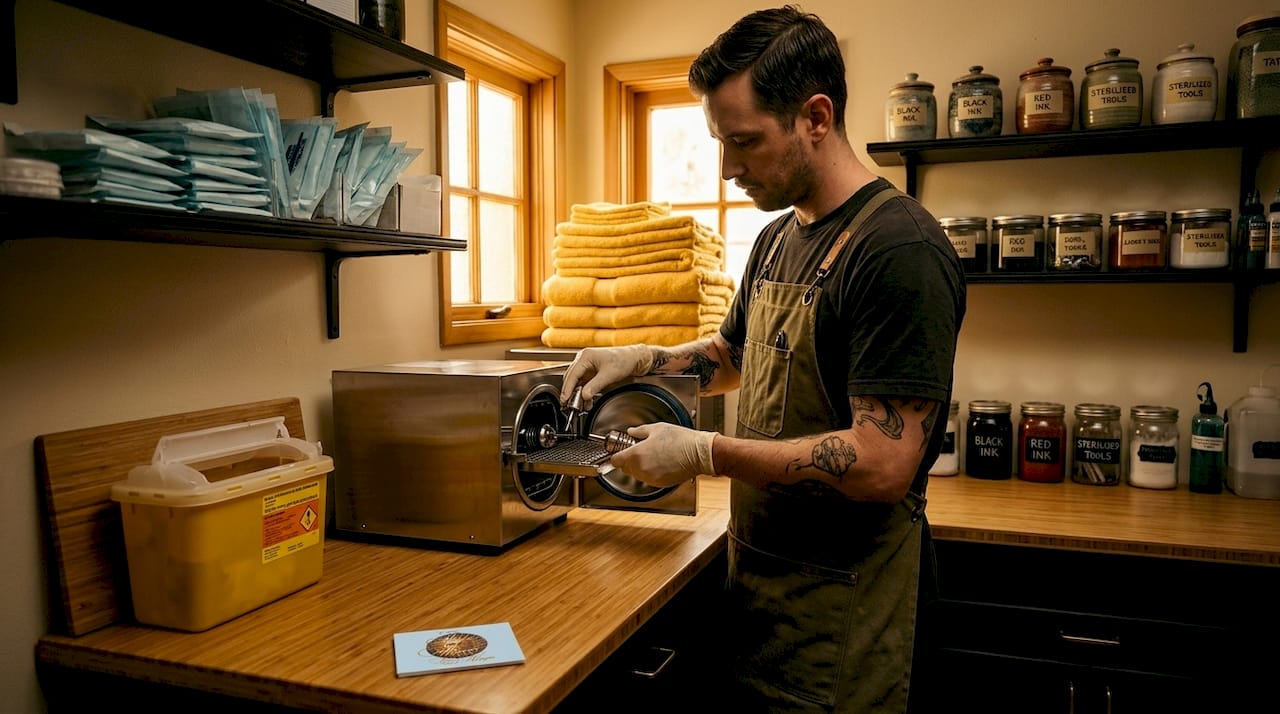
Autoclave machines sterilize reusable equipment by using pressurized steam at high temperatures. But owning one is not enough. A quality studio tests autoclave sterilization monthly using biological spore tests and keeps those logs on file for three years. If a studio cannot show you recent spore test records, the autoclave may not be working properly even if it looks clean.
Single-use needles are standard, but the detail that separates good studios from great ones is when they open them. Your artist should open a sealed needle package in front of you, every time. Maintaining what professionals call a "sterile bubble," which means keeping the work area free from cross-contamination, also means fresh gloves and medical-grade cleansers prevent the vast majority of infection risks during a session.
Hygiene checklist for your visit:
- Autoclave spore test logs available and current
- Sealed needle packages opened in your presence
- Gloves changed between each client and after any interruption
- Sharps containers properly labeled, not overfilled
- Work surfaces wiped with medical-grade disinfectant before your session
- No shared ink between clients; fresh ink cups used each time
Pro Tip: Do a quick visual scan when you walk in. Are surfaces clean? Is there a sharps container visible near the workstation? Does the studio smell like a clean medical environment rather than something stale? Your first impression is often accurate.
Transparent portfolios showing healed tattoo quality
This is where many clients make their biggest mistake. Fresh tattoos almost always look sharp. The ink is saturated, the lines are crisp, and the skin has not had time to reveal any underlying issues. Healed tattoos are the real test.
A quality artist will have a portfolio that includes work photographed 6 to 12 months after completion. At that stage, you can see whether lines have held their shape, whether shading has stayed even, and whether color has retained its saturation without muddying or fading unevenly. Fine line work, in particular, is notorious for revealing skill gaps once healed. Thin lines can blur, spread, or disappear entirely if the artist does not have the right technique and needle depth.
What to look for in a portfolio:
- Healed photos clearly labeled as such, not just fresh work
- Consistent style across multiple clients and body placements
- Even shading with no patchiness or blowouts (ink spreading beyond the intended line)
- Cover-up examples if relevant, showing the artist can handle complex layering
- Work on different skin tones, which demonstrates versatility and technical range
A portfolio that only shows fresh tattoos under perfect studio lighting is not a complete picture. Ask directly whether the artist has healed examples. A confident, skilled artist will be proud to show them.
Professional client care and consultation experience
The best tattoo studios treat the consultation as a collaboration, not a transaction. This is one of the clearest indicators of quality tattoo shop culture, and it is easy to assess before you ever sit in the chair.
During a consultation, your artist should ask questions about your vision, your lifestyle, and how the tattoo will age on your specific placement. They should offer informed suggestions without overriding your preferences. Pressure tactics or dismissiveness are red flags, whether that means rushing you into a booking or making you feel uninformed for asking questions.
Paperwork matters too. Consent forms outlining risks and aftercare are a legal and ethical standard, not a bureaucratic inconvenience. A studio that skips them is cutting corners in a way that should concern you.
Signs of a respectful, professional consultation:
- Artist listens before offering design input
- Questions are welcomed without impatience or condescension
- Written consent form provided and explained, not just handed over
- Aftercare instructions given in writing, not just verbally
- Deposit and cancellation policies clearly stated upfront
- No pressure to book immediately or upgrade to a larger piece
Pro Tip: Pay attention to how the studio handles your first inquiry, whether by email, phone, or in person. Response time, tone, and clarity in that first interaction are a preview of how they will treat you throughout the entire process.
Quality ink and supply sourcing with safe storage
What goes into your skin matters as much as the technique used to put it there. Tattoo inks are regulated as cosmetics without pre-market FDA approval, which means the responsibility for sourcing safe materials falls entirely on the studio. Reputable studios choose suppliers who provide batch tracking and test for heavy metals and contamination.
This is not a minor detail. Contaminated or low-quality inks can cause allergic reactions, granulomas (small inflammatory nodules under the skin), and long-term skin issues. Fine line work, which relies on precise pigment placement, is especially sensitive to ink quality because the margins for error are smaller.
What a quality studio does with its inks:
- Sources from reputable manufacturers with documented testing and batch tracking
- Uses single-use ink caps for every session to prevent cross-contamination
- Stores inks in clean, sealed containers away from direct sunlight and heat
- Discloses ink brands when asked without hesitation
- Avoids mixing unknown pigments or using inks past their expiration date
Comparison table: key signs of quality tattoo studios
Use this table as a quick reference when you are evaluating studios in Los Angeles.
| Quality indicator | What to look for | Red flag |
|---|---|---|
| Licensing | Visible facility permit and artist licenses | Reluctance to show credentials |
| Sterilization | Monthly autoclave logs, sealed needle packs | No spore test records available |
| Portfolio | Healed tattoo photos, consistent style | Only fresh work, no healed examples |
| Consultation | Collaborative, patient, written consent | Pressure tactics, no paperwork |
| Ink and supplies | Reputable brands, single-use caps, transparent sourcing | Unknown brands, reused ink cups |
What the industry gets wrong about "quality"
Most conversations about tattoo studio quality focus entirely on the artist's technical skill. That matters enormously, but it is only part of the picture. We have seen clients walk away from technically gifted artists because the experience felt impersonal, transactional, or uncomfortable. And we have seen the opposite: studios with beautiful Instagram feeds that could not answer a basic question about their sterilization protocols.
The uncomfortable truth is that a truly great studio is built on systems, not just talent. Consistent hygiene, transparent communication, and careful material sourcing are not glamorous. They do not photograph well. But they are what protect you, and they are what allow an artist's skill to actually show up in the final work without interference from preventable problems.
In Los Angeles specifically, the market is saturated enough that you do not have to compromise. You can find studios that meet every standard on this list and also produce genuinely beautiful, personalized fine line work. The key is knowing what questions to ask before you sit down. Most clients never ask about autoclave logs or ink sourcing. The ones who do tend to end up with better experiences, better tattoos, and no regrets.
Experience the standard at The Sunroom LA
If you are looking for a studio in Los Angeles that takes every one of these indicators seriously, The Sunroom LA was built around exactly these principles.
At The Sunroom LA, every session is private, personalized, and focused on fine line and custom artistry. The studio is designed for clients who want more than a walk-in experience. You get a collaborative consultation, a comfortable and clean environment, and an artist who treats your vision as the starting point, not an afterthought. If you are ready to book a custom tattoo with a studio that earns your trust before you ever sit in the chair, explore the portfolio and booking process to get started.
Frequently asked questions
What licenses should a quality tattoo studio display in Los Angeles?
Studios should prominently display a valid tattoo practitioner license and facility permit as required by California's Safe Body Art Act and local health departments. Both the studio and each individual artist must hold current credentials.
Why are autoclave spore tests important for tattoo studios?
Monthly autoclave spore tests confirm that sterilization equipment is actually killing harmful biological material, not just running through a cycle. Studios should maintain spore test logs for a minimum of three years as proof of consistent compliance.
How can I verify a tattoo artist's skill before getting inked?
Ask specifically for healed tattoo photos rather than relying only on fresh work. Healed photos at 6 to 12 months reveal whether lines have held, shading has stayed even, and color has remained consistent over time.
Should tattoo studios use FDA-approved inks only?
Tattoo inks do not require pre-market FDA approval since they are classified as cosmetics. However, reputable studios use inks from manufacturers who conduct heavy metal testing and batch tracking, which is the responsible standard in the absence of mandatory pre-approval.